
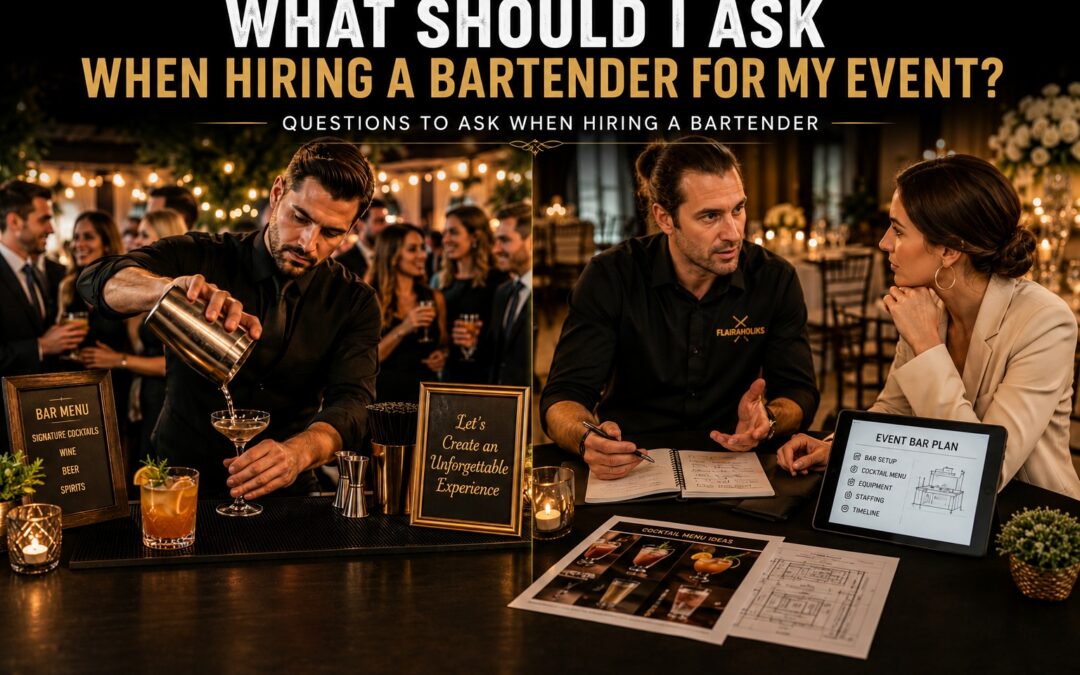
Professional flair bartender and traditional bartender working at upscale events.
What Should I Ask When Hiring a Bartender for My Event? – questions to ask when hiring a bartender
If you are searching for the best questions to ask when hiring a bartender, the most important thing is understanding that you are not just hiring someone to pour drinks. You are hiring someone who can directly affect guest experience, service speed, event flow, and even liability at your event. The right bartender can elevate an event. The wrong one can create delays, confusion, poor guest interactions, and unnecessary risk.
Whether you are planning corporate events, weddings, cocktail parties, or private events, asking the right questions before booking will save you stress later.
Quick Answer / Overview – questions to ask when hiring a bartender
The most important questions to ask when hiring a bartender are:
- Are they properly insured with general liability and liquor liability coverage?
- Do they have experience specifically working events?
- Can they help with logistics, setup, alcohol planning, and guest flow?
- What equipment do they provide?
- Do they understand the style and atmosphere you are trying to create?
- Can they adapt the bartending experience to fit the event theme?
A bartender is not just a service position at an event. A professional event bartending company should also help guide setup, bar placement, drink planning, and overall guest experience.
The Most Important Questions to Ask Before Hiring
Are They Properly Insured and Licensed?
This is one of the most overlooked parts of hiring bartenders for events.
Different states and venues may require:
- Bartending permits
- Alcohol service certifications
- Venue-specific credentials
- Liquor liability insurance
- General liability insurance
Even if the bartender is not supplying the alcohol, alcohol service still creates liability exposure for the event itself.
Professional event bartending companies should be able to clearly explain:
- What insurance they carry
- What licensing they have
- What venue requirements they meet
This is especially important for:
- Corporate events
- Weddings
- Casino venues
- Hotel venues
- Large private parties
If a bartender cannot clearly answer these questions, that is a major red flag.
What Experience Do They Have With Events?
There is a huge difference between:
- restaurant bartending
- nightclub bartending
- event bartending
A bartender who works behind a fixed restaurant bar may be excellent at making drinks, but events require completely different logistics.
An experienced event bartender understands:
- mobile bar setup
- equipment transport
- ice management
- temporary workspaces
- guest flow
- high-volume service
- adapting to unpredictable environments
At events, nothing is automatically within arm’s reach. Everything must be planned, transported, staged, and executed efficiently.
This is where experience matters.
Are They Organized as a Professional Business?
One of the smartest questions to ask when hiring a bartender is whether they operate as an actual event business or are simply showing up to bartend for the night.
Professional bartending companies often help with:
- cocktail menu planning
- alcohol ordering guidance
- shopping lists
- rentals
- staffing recommendations
- timeline coordination
- venue logistics
- custom drink creation
The best bartenders do not just arrive and start pouring drinks. They help build the bar experience before the event even begins.
References also matter here. A company with real event experience should be able to provide examples of past events, client feedback, or referrals.
What Actually Makes This Work (Insider Perspective)
One of the biggest misconceptions about bartending entertainment is that guests only care about the drinks.
They do not.
Guests remember experiences.
The bar is one of the most visited areas of almost every event. People return to it multiple times throughout the evening. That means the bar naturally becomes part of the atmosphere.
The mistake many planners make is treating the bar like a utility station instead of part of the event design.
A standard bartender in a white shirt and black tie may look professional, but does that actually fit the event?
Sometimes it does.
Sometimes the event would benefit from:
- flair bartending
- themed uniforms
- interactive bartending entertainment
- molecular mixology
- custom cocktail presentations
- branded experiences
The best event bartending setups feel integrated into the event itself.
For example:
- corporate events may benefit from polished bartending entertainment that encourages guest interaction
- weddings may benefit from elegant custom cocktails and visually styled bars
- private parties may benefit from flair bartending that creates energy and conversation
The goal is not always “bigger.” The goal is alignment with the event itself.
Practical Tips When Booking
Ask What the Bartender Needs to Succeed
This is one of the most valuable but least asked questions.
Many event planners assume bartenders can simply “make it work.”
Professional bartenders usually can adapt, but the quality of service depends heavily on setup conditions.
Ask about:
- workspace size
- bar dimensions
- ice access
- sink access
- power access
- storage
- lighting
- guest traffic flow
For example, flair bartending typically requires more working space than standard service bartending.
Likewise, a sommelier-style wine experience may require a more visible and presentation-focused setup.
The better the working environment, the smoother and faster the service.
Ask About Equipment
Never assume bartenders automatically provide everything.
Ask specifically about:
- bar tools
- coolers
- ice bins
- garnish trays
- mixers
- portable bars
- glassware
- menus
- signage
Clarifying this early prevents last-minute problems.
Ask for Input on Bar Placement
Experienced event bartenders understand guest flow better than many planners realize.
Where you place the bar affects:
- crowd movement
- wait times
- guest interaction
- energy distribution throughout the venue
A bartender who regularly works events can often immediately identify:
- where bottlenecks may happen
- where lines may build
- where service will work best
Use that experience.
Alternatives or Variations
Standard Bartending
Best for:
- straightforward service
- cocktail hours
- formal dinners
- events where the bar is secondary
This style focuses on efficient drink service and professionalism.
Flair Bartending
Best for:
- high-energy events
- corporate events
- brand activations
- parties focused on entertainment
- interactive guest experiences
Flair bartending combines drinks with performance and bartending entertainment.
The important thing is understanding whether the event benefits from that energy.
If guests are expected to spend time socializing around the bar, flair bartending can dramatically increase engagement.
If the event is simply transitional service before another activity, standard bartending may be the better fit.
Molecular Mixology or Specialty Experiences
Best for:
- luxury events
- experiential events
- premium corporate gatherings
- immersive themed events
These styles work best when guests are expected to interact with the bar experience itself.
When This Is the Best Choice
Hiring professional event bartending is perfect if:
- guest experience matters
- the bar is central to the event atmosphere
- you want smoother logistics
- you want help planning the bar itself
- you want bartending entertainment integrated into the experience
- you want expert guidance on alcohol, cocktails, and setup
It may not be ideal if:
- you only need minimal drink service
- the event is extremely short
- the bar is purely functional
- there is no space for proper setup or interaction
Final Thoughts
The best questions to ask when hiring a bartender are not just about drinks.
They are about:
- experience
- logistics
- insurance
- guest interaction
- event flow
- atmosphere
- planning support
A professional bartender or bartending company should function like a partner in your event planning process, not simply someone standing behind a bar.
The more you involve the bartender in planning, layout, cocktail design, and logistics, the smoother your event will run.
And in many cases, the bar can become one of the most memorable parts of the event itself.
For professional flair bartending, event bartending, and bartending entertainment for corporate events, weddings, and private parties, visit Flairaholiks